
Bird of the Month: Evening Grosbeak
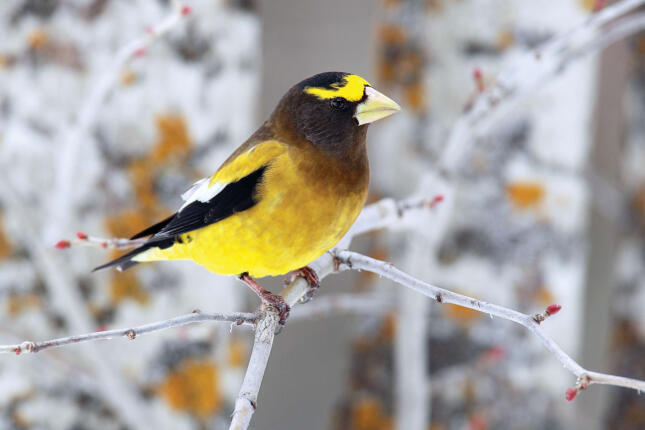
The Evening Grosbeak is one of the most visually captivating birds to visit Western North America in winter. With its thick ivory bill, bold wing patterns, and vibrant swaths of gold, the species is unmistakable. As a kid, I always said they looked like they were wearing yellow sunglasses, but I recently heard them described as having the vibe of a retro ski shop, and I think it's a perfect description of their overall look. They look ready to hit the slopes rather than the feeder! These finches are striking, charismatic, and wonderfully unpredictable, which is why they make a perfect Bird of the Month for December 2025.
The scientific name of the Evening Grosbeak is Hesperiphona vespertina. “Hesperiphona” roughly translates to “evening sound,” a reference to an early but incorrect belief that the species sang only at dusk. Despite the name, Evening Grosbeaks are not truly evening birds, their name reflects a historical misunderstanding rather than their true habits.
For much of North American history, Evening Grosbeaks were primarily western birds. They occupied the dense conifer forests of the Rocky Mountains and Canadian boreal region, showing a strong association with spruce, fir, and mature pine. Eastern appearances were once extremely rare, but beginning in the late nineteenth century, the species began expanding far beyond its traditional boundaries. One of the main reasons for this expansion was the widespread planting of box elders, which provide a steady winter food source. With the new availability of seeds and buds in cities and towns, Evening Grosbeaks slowly spread eastward, eventually becoming winter visitors throughout the northern United States and even the northeastern seaboard.
Their movements are shaped by food more than by temperature or day length. This makes them what ornithologists call an irruptive species, a bird whose winter distribution changes dramatically from year to year. Some winters pass with only a handful of reports in Colorado. Other years see enormous flocks moving down from the north, filling mountain valleys and even appearing along the Front Range. The 2025 winter season is widely expected to be an irruption year, which means birdwatchers in Colorado have an excellent chance of seeing these gorgeous finches in greater-than-average numbers!
For local feeders, this possibility adds a layer of anticipation and joy. Evening Grosbeaks are exceptionally fun to host. They arrive boldly, often in groups, and gather around feeders with a confidence that makes them easy to observe. They crack seeds with astonishing force, toss fragments aside with casual skill, and communicate with crisp “chip” calls that travel clearly through cold winter air. Everything about them feels alive, which is why many birders consider a grosbeak visit to be a true highlight of the season.
Appearance and Basic Information
Evening Grosbeaks are among the largest finches in North America. Adults typically measure between seven and eight and a half inches in length, with a wingspan that can exceed a foot. They are thick-bodied, compact birds with a substantial silhouette. Much of their robustness is owed to their enormous bill, which is shaped like a cone but much thicker and more powerful than a typical finch bill. This structure gives them the ability to crack seeds into pieces that smaller finches cannot manage.
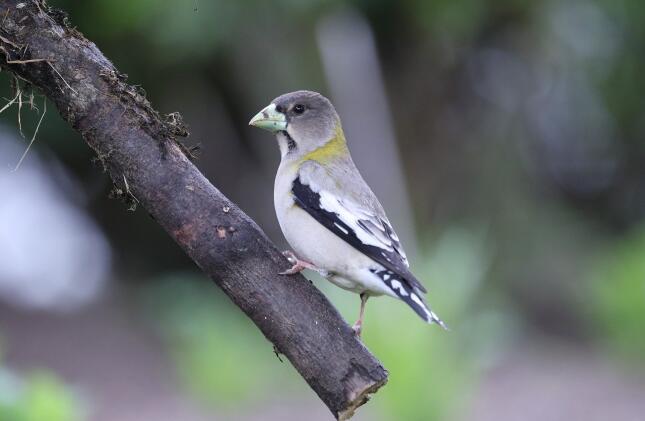
Males are especially striking. Their bodies are rich golden yellow, framed by deep brownish-black wings accented with prominent white patches. A bold stroke of yellow appears above each eye like a painted brow. Females have a more subdued appearance, with soft gray bodies warmed by hints of buff or olive. Their wings still show black and white patterning, although the contrast is gentler. Both sexes share the same impressive bill.
These birds are strongly social, particularly during fall and winter. While they break into small units for breeding, they reassemble into flocks outside the nesting season and travel widely in search of food. Their flight is strong and direct. When they approach a feeding station, the flock often announces itself through a chorus of clear, ringing notes that sound almost metallic. Many birders hear Evening Grosbeaks long before they see them.
Habitat Across the Seasons
Evening Grosbeaks live in a wide range of forested areas, although they show a strong preference for mature conifer stands. Spruce, fir, hemlock, and high-elevation pines are especially important. In Colorado, they are most associated with mid- to high-elevation forests that provide both summer nesting grounds and abundant insect prey.
Their summer habitat is often remote, quiet, and densely wooded. They choose areas where tall conifers dominate the canopy and where thick branches provide both nesting sites and protection. These forests offer caterpillars, beetles, and other insects during the breeding season, along with buds and seeds as summer transitions to fall.
During winter, their habitat expands considerably. Because Evening Grosbeaks adjust their movement patterns based on food availability, they may appear in towns, suburbs, foothills, or even lowland parks. Irruption years often bring them into places where they have not been seen for several years. When natural food crops fluctuate, they travel widely and opportunistically, sometimes appearing at feeders hundreds of miles from their usual range. This unpredictable movement is part of the species’ appeal!
Diet and Feeding Preferences
The diet of the Evening Grosbeak changes substantially through the seasons. During spring and summer, the birds rely heavily on insects, especially spruce budworms. Budworms undergo population cycles that range from explosive outbreaks to long periods of scarcity. Evening Grosbeaks seem to track these cycles; when budworms crash, the birds sometimes wander widely in search of new food sources.
Budworms are an essential part of the breeding diet because they provide protein for growing chicks. Adult birds also consume large quantities of other insects such as leafhoppers and aphids, along with buds from deciduous and coniferous trees.
Once autumn arrives, the diet becomes more seed-based. Maple seeds, ash seeds, box elder samaras, conifer seeds, and wild fruits all become important. Evening Grosbeaks are also enthusiastic consumers of sunflower seeds and pine seeds. Their powerful bills allow them to access food that is too tough for many other finches.
At backyard feeding stations, Evening Grosbeaks show a strong preference for sunflower chips and safflower. They also readily take black oil sunflower seed and nut-based blends. Their large size means they do best with platform feeders, large hopper feeders, or sturdy tray setups where they can land comfortably. When a reliable food source is available, they often return repeatedly throughout the day.
Mating and Courtship
Evening Grosbeaks have a gentle, understated approach to courtship. Unlike some finches that display elaborate songs or vibrant dances, grosbeaks depend more on soft calls, small gestures, and mutual attention. Males may offer females food, passing seeds delicately from bill to bill. This behavior is one of the most common bonding activities in the species. It reinforces trust and helps establish a partnership that will carry through the breeding season.
A courting male may flutter his wings slightly or bow toward the female in a modest display. Compared to the flamboyant courtship of many bird species, the grosbeak’s approach is quiet and subtle. Once paired, the birds remain monogamous for the season.
Nesting and Raising Young
Evening Grosbeaks typically nest in dense conifer forests. The female selects the nesting site, usually positioning the nest on a horizontal branch ten to sixty feet above the ground. Placement depends on the height and structure of available trees, but the goal is always the same: safety and concealment.
The female builds most of the nest. She gathers twigs, grasses, roots, lichen, and other soft materials to create a loose cup. Although the construction sometimes appears flimsy at first glance, it functions well within the stable, sheltered environment of the forest canopy.
A typical clutch contains two to five eggs. The eggs are pale blue or blue-green with scattered dark speckles. The female does almost all of the incubation, which lasts around twelve to fourteen days. During this time, the male brings food to her and remains nearby, offering protection and assistance.
Once the eggs hatch, both parents feed the chicks. The young grow rapidly, fueled by a diet rich in insects and softened seeds. They leave the nest at roughly two weeks of age, a surprisingly early stage in their development. Fledglings appear a bit unsteady at first, but their flight skills improve quickly. For another two to three weeks, the parents continue to feed them and teach them how to forage. By about five weeks after hatching, most young Evening Grosbeaks have transitioned to independence.
Spotting and Attracting Evening Grosbeaks
Attracting Evening Grosbeaks is easier during irruption years, although they may appear at any time when food becomes scarce in their typical winter range. The first step is simply to be prepared. If you live in Colorado, 2025 is expected to be a very promising year, so keeping feeders well stocked from late fall through winter can greatly increase your chances.
Food is the key. Sunflower chips are the top choice, but safflower and black oil sunflower seeds are also excellent options. A mix that includes nuts or dried fruits can keep them engaged as well. Because grosbeaks travel in flocks, providing multiple feeding stations or larger feeders helps reduce crowding and gives more birds space to feed comfortably.
Water is equally important. A heated birdbath can attract grosbeaks even when natural sources are frozen. These birds appreciate shallow, open water that remains unfrozen throughout the coldest months.
Listening is one of the best ways to detect grosbeaks. Their clear “chip” calls can carry astonishingly far through still morning air. Learning that sound allows you to notice their presence before the birds come into view.
Finally, it is essential to make windows safe if you hope to host Evening Grosbeaks. Their powerful, fast flight and flocking behavior make them especially vulnerable to window collisions. Window Gems, Feather Friendly dot patterns, exterior screens, or ultraviolet decals greatly reduce these risks and play a valuable role in conservation.
Conservation Concerns
The conservation story of the Evening Grosbeak is complex and pressing. Over the past forty years, their populations have fallen dramatically. Estimates vary, but many studies suggest that the species has declined by more than fifty percent. Some regions report losses approaching ninety percent.
Several factors are contributing to their decline. Habitat loss is a major concern. The mature conifer forests on which Evening Grosbeaks depend have been reduced through logging and forest fragmentation. Declines in spruce budworm cycles present another challenge. Budworms are periodically controlled through large-scale management programs, and although these programs are beneficial for forestry, they reduce a critical food source during the breeding season.
Window collisions are another significant cause of mortality. Because Evening Grosbeaks travel in flocks and fly quickly, they are at heightened risk, particularly in residential areas where reflections can be misleading.
Climate change adds further pressure. As temperatures rise and precipitation patterns shift, conifer forests across North America face increased stress. Wildfire patterns, drought, and insect outbreaks all affect the health of breeding habitats. Declines in box elders and other seed-bearing trees may also reduce winter food sources, especially in the southern parts of their winter range.
Finally, there is a lack of long-term monitoring data. Because Evening Grosbeaks move unpredictably and do not follow stable migration patterns, they are difficult to track through conventional surveys. Citizen science programs such as eBird, Project FeederWatch, and Christmas Bird Counts have become invaluable. These community-driven resources help researchers piece together a clearer picture of population trends and seasonal movements.
The expected irruption in 2025 offers an important chance to raise awareness about these issues. Bird enthusiasts can share information about window safety, habitat conservation, and the value of citizen science. Feeding stations provide nourishment, but education provides understanding, and that understanding helps create a future in which Evening Grosbeaks remain a vibrant presence in winter landscapes.
The Evening Grosbeak is a bird of contradictions. It is bold in color but quiet in song, large yet graceful, nomadic yet tied to specific food cycles, and familiar in winter but almost secretive in summer. These qualities are part of what makes the species so special.
This irruption year may give Colorado birdwatchers an exceptional opportunity to see and appreciate Evening Grosbeaks. Their visits remind us of the intricate connections between forests, insects, seeds, climate, and human patterns of land use. More importantly, their bright presence brings joy, awe, and a sense of wonder to backyard feeders during the deepest part of winter.
By understanding their habits, supporting conservation efforts, making windows safe, and celebrating their beauty, we can help ensure that these spectacular finches continue to brighten our winters for generations to come!